Looking for some ideas on making the unremembered memorable? Get in touch with the team – we’d love to talk.


by Rebecca Broomfield, Director of Consumer
There are some categories that are marked by the industry as low interest – bin bags, insurance, boilers, appliances… But this is a simplification, and in my opinion it’s mostly wrong.
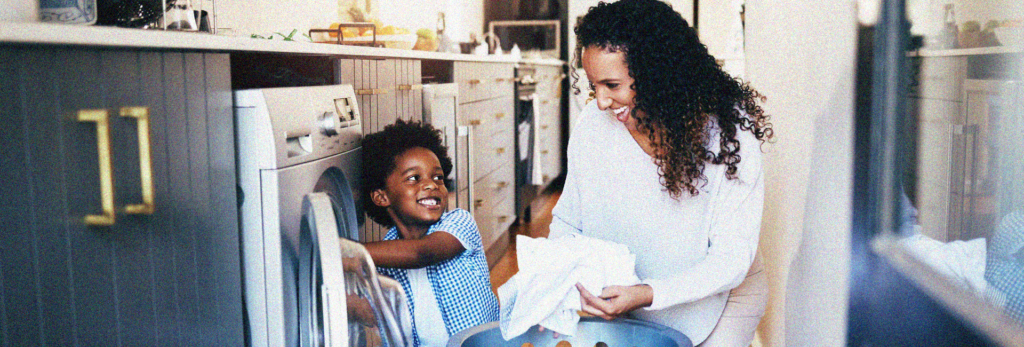
Interest in white goods isn’t low, it’s latent. Nobody thinks about their washing machine, right up until the moment it stops mid-cycle with the school uniform inside. Then interest goes from zero to max in about four seconds. The category doesn’t lack emotion, it stores emotion up and releases it all at once, usually at the worst possible time.
What’s actually low is salience – how readily a brand comes to mind when that moment arrives.
If you believe interest is the problem, you set out to make the category interesting, and your brand interesting by association. It rarely works, and when it does the cause is usually something outside the marketing plan.
Disinfectant brand Zoflora launched in Britain in 1922 and sat quietly on shelves for the best part of a century, until the rise of Mrs Hinch. By November 2018 the papers were reporting empty shelves, and the factory in Huddersfield had doubled production to keep up. Mrs Hinch wasn’t recruited as an ambassador, she simply liked the product, and a dormant brand woke up inside her cultural moment. Which makes it a great story and a terrible strategy. Nobody can, with any integrity, put “get a record-breaking influencer to fall in love with us” in the marketing plan.
The brands that have reliably cracked these categories didn’t try to make their products interesting either. Compare the Market never made insurance interesting – it made a meerkat unforgettable. Specsavers doesn’t talk about optometry – it attached itself to the universal moment of misreading something in public, then spent twenty years being ready. Which is why, when the Bayeux Tapestry arrived in Britain this month for the first time in 950 years with an arrow through Harold’s eye, Specsavers didn’t need a strategy meeting.
If you accept that salience is the problem, the job changes completely. You don’t have to make people care about appliances. You have to be present at the moments when they already care. Appliances get replaced years apart, and rarely as a considered upgrade. The trigger is a breakdown, a house move or a kitchen refit. The window is very short and unpredictable. By the time someone is searching, the decision is a race between whoever is already in their head and whoever is top of the results page.
Which means the strategic question in a low-salience category isn’t “how do we make this interesting?” It’s “when is this felt?”
Reliability is an easy claim to make but it’s a hard thing to make someone feel.
For Beko, we looked for the point in the year when reliability stops being a spec and becomes a lived experience. We landed on Back to School. After weeks of lie-ins, loose routines and picky teas, the household goes back to full speed overnight. Washing machines running at midnight. Tumble dryers rescuing PE kits. Fridges stocked for five days of packed lunches. Every appliance in the house earns its place inside the same fortnight.
So we stopped talking about reliability specs and started talking about life specs: the moments when things absolutely have to work, and the quiet relief when they do.
Latent interest surfaces in conversation long before it surfaces in search. For parents, that conversation happens in the group chat, with 82% relying on WhatsApp as an essential parenting tool.
So Beko went into the group chat. We built a Back-to-School WhatsApp Helpline hosted by former teacher and bestselling author Lou Beckett, who knows something about family chaos as one half of the Beckett household with Rob Beckett of Parenting Hell.
Humour was the way in because parents don’t bond over getting everything right, they bond over the shared chaos of trying. Creator partnerships took the idea into real family conversations, and the work landed 250 pieces of coverage including The Sun, Daily Mirror, Daily Express and Daily Star.
1. Map when the category is felt, not when it’s bought. Seasonal peaks, admin deadlines, weather, life stages, the first cold night of the year. These are predictable and most competitors ignore them.
2. Trade the product spec for the life spec. Nobody wants a 1400rpm spin. They want the kit dry by Tuesday.
3. Enter a room people are already in. Group chats, school gates, comment sections. Low-salience brands don’t get an audience to assemble for them. They have to turn up where one already exists.
4. Give people something worth passing on. Salience is built by repetition, and the cheapest repetition is the kind you don’t pay for.
Low-salience categories are quiet. Very few brands in them are doing anything memorable, which means the bar for becoming the one brand that comes to mind is far lower than it would be in a crowded, high-interest category. The key is consistency, showing your audience repeatedly where the brand has a meaningful role.
This is what we mean by PR for Real Lives: finding the moment a brand promise actually matters, then bringing it to life in a way people recognise in their own lives.

Looking for some ideas on making the unremembered memorable? Get in touch with the team – we’d love to talk.