

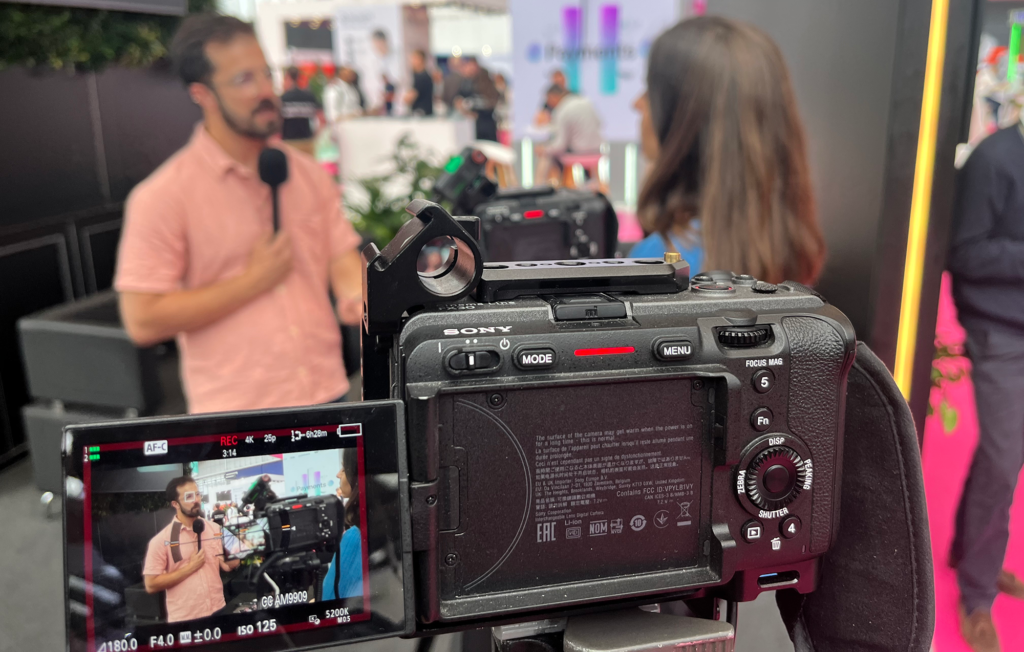
“The best Money 20/20 in seven years” declared Louisa Murray, CSO of the newly combined Equals Money x Railsr, on leaving the RAI in Amsterdam.
Once again the halls were filled with Europe’s biggest banks, neo-banks and payment providers, with six stages of talks and a packed press lounge throughout. Despite recent tariff turbulence, the mood was upbeat and trade wars barely mentioned.
On the stands, you could whack-a-mole to catch fraud, meet Sami Hyypiä with Chartered Bank or win a LEGO F1 car with VISA. After the popular Money Street party in Soho on Tuesday, Annie Mac closed the Wednesday night with a perfectly pitched good times DJ set on the Garden stage which saw execs dancing in mirror ball hats.
But where does the industry stand in 2025? Beyond the clinking glasses and the card launches, seven themes stood out:
Monzo’s CEO TS Anil opened day two by declaring a race between legacy banks and fintechs, with the former racing to catch up with technology and the latter seeking to offer more traditional banking services.
The power of fintechs has always been in their ability to move at speed. Without the baggage of legacy infrastructure, nor the regulatory constraints of traditional banks. Fintechs have exploded in the last decade due to their ability to offer innovative new ways of making payments and providing financial services that prioritise customer experience.
Banks have adapted by working with fintech partners to offer their customers these services, but this is a short-term solution. The fundamental decision is at what point they migrate their legacy systems to the cloud. This migration would save money, improve speed and data linkage – all areas in which neo banks established directly on cloud systems can compete.
The UK’s Thought Machine is one of the leading providers in cloud banking infrastructure. Gareth Richardson, COO believes that AI could be the tipping point. “You need to know where your customer is” he says. With siloed products, using cobalt, “it could take almost two months to know actual position of customer”. The cloud, however, offers a single view with potential for interoperability and allowing for AI integration. “One bank we worked with had 20m lines of COBOL (code) for their current account” says Gareth. “We re-platformed this to 20k lines”
AI was a key theme in the talks programme, but this year it feels like a transformation already well underway. A Censuswide survey commissioned by Equals Money and published at the show found that 81% of European finance teams increased their automation usage over the past year.
Meanwhile Klarna’s CMO David Sandström declared that it was the company’s ‘culture around AI’ that would set it apart, as people ‘actually embrace it on a daily basis.’ He was at the show to promote the new, physical Klarna Card as ‘the future of everyday banking’.
Embedded finance was a massive buzzword at the show – popping up as one of the services offered on every other stand – but few are as well placed to deliver on it’s promise as the newly combined Equals Money and Railsr.
“It has been a cottage industry” says Philippe Morel, who took the helm at Railsr two years ago, before the recent deal with Equals Money to become co-CEO with Ian Strafford-Taylor. “Many are not profitable. We need to start consolidating sector and we need to make sure we are profitable to protect people’s money.” The new combined business is now one of the largest players in Europe, with global expansion in its sights.
One of the benefits of embedded finance is that non-banks get to understand more of their customers’ financial journey and can offer further relevant financial products as a result.
It was interesting to hear how Zopa Bank is taking a similar approach with its first current account. They’re talking about being able to offer banking products as helpful ‘features’ at the different stages of an individual’s life / financial journey, rather than the traditional ‘siloed’ banking products. This echoes the embedded finance approach to offering customers banking products where they need them.
The “current account product brings the whole ecosystem together” says Merve Ferrero, Chief Strategy Officer “It gives us more data for understanding (customer’s) lives and thinking about their financial wellbeing. We can help them”
The neo bank has created a business model that generates value, from the efficiencies of a cloud based fintech platform, and gives it back to customer. “We want to offer the best value at the lowest effort to customer”, she says.
Fraud remains a challenge for banks, payment providers and their regulators, but the best talk on the topic came from Luke Charters, who was elected Labour MP for York Outer in 2024, following a career in financial services. “The UK is on the dawn of a new era of tackling fraud” he declared on the Mastercard Horizon Stage.
“There was a worry that people would be less vigilant about fraud” when the UK launched it’s £85k compensation scheme, he said but that’s not the biggest challenge. “We need to do more around fraud origination” he says “So much of APP originates on social media platforms”, who are “not doing enough.”
The industry is doing great he says, innovating on know your customer, but “The biggest jeopardy I see is fraud as a service” Some of “the ways organised crime groups are using AI keeps me awake again night” he admits, giving examples of vulnerable constituents falling victim to celebrity romance scams.
The solution, he says is to “disrupt the technology” and for that we ”need to pair meta data with transaction data. Once you have the data can change the way you do policing.” It is about disruption and take down, not people in handcuffs.” He says: “That’s the global coordination challenge we’ve got.”
One solution to the fraud problem is open banking – but it has come under fire in recent months amid claims that the promise of the technology has yet to deliver.
The key stumbling block was brought up during a session on what EU and UK regulators can learn from each other: “How do we close gap of consumer protection and chargebacks of cards?” asked a member of the audience.
“You need to remember that it’s a very young industry” said Henke Van Hulle, CEO of Open Banking “Cards are 67 years old. We need (to make) a scheme or rulebook… but you can go upstream to avoid chargebacks using account-to-account (A2A) for faster payments. iDEAL (now rebranding to Wero) in Holland works well.” Deutsche Bank / Mastercard and Revolut / Wero both announced new A2A partnerships at the show.
“The Dutch system works well because they don’t have a credit culture”, clarifies James Simcox of Equals Money x Railsr. “But if we can address the issue of consumer protection there is huge potential for open banking to allow better data sharing between providers to combat fraud.”
As at Pay360, stablecoins were another buzzword at Money 20/20, thanks to their potential for international transactions and making payments faster.
“The rise of crypto and stablecoins is a major event” says Morel “We saw the potential at Setl (his previous fintech), but now we have use cases and can start providing access to stablecoins as payment rails.”
From cloud-powered speed to AI’s daily embrace, this year’s Money 20/20 confirmed one thing: the future of finance is here already, embedding faster, smarter and more secure payments into our daily lives.
Check out our videos for Equals Money x Railsr on the LinkedIn page here. You can also read the results of our European finance automation survey here.
To discuss your fintech communications strategy, contact Chris Baker, Senior PR Consultant: 07983 079640 | [email protected]